
Table of Contents
- Introduction
- What Is a Series Circuit?
- How a Series Circuit Works
- Advantages of a Series Circuit
- Disadvantages of a Series Circuit
- What Is a Parallel Circuit?
- How a Parallel Circuit Works
- Advantages of a Parallel Circuit
- Disadvantages of a Parallel Circuit
- Series Circuit vs Parallel Circuit: Major Differences
- Applications of Series Circuits
- Applications of Parallel Circuits
- Which Circuit Is Better?
- Conclusion
- FAQs
Introduction
Electrical circuits are an essential part of modern life. From household appliances and lighting systems to electronic devices and industrial equipment, circuits help power the technology we use every day. Two of the most common circuit configurations are series circuits and parallel circuits. Understanding the differences between these two types of circuits is important for students, electricians, engineers, and anyone interested in basic electrical concepts.
Although both series and parallel circuits allow electricity to flow, they operate in different ways and have unique advantages and disadvantages. This article explains how each circuit works, compares their characteristics, and discusses their practical applications.
What Is a Series Circuit?
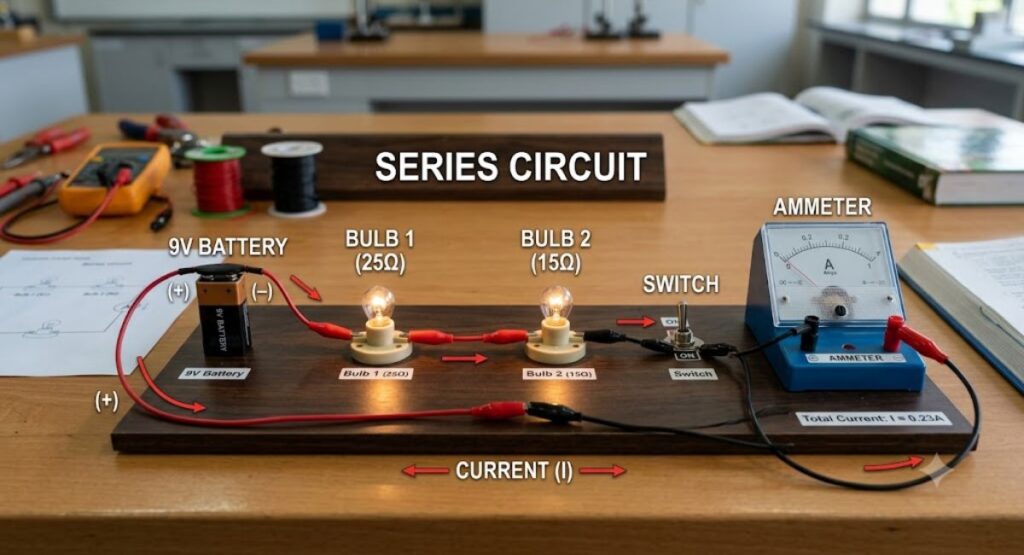
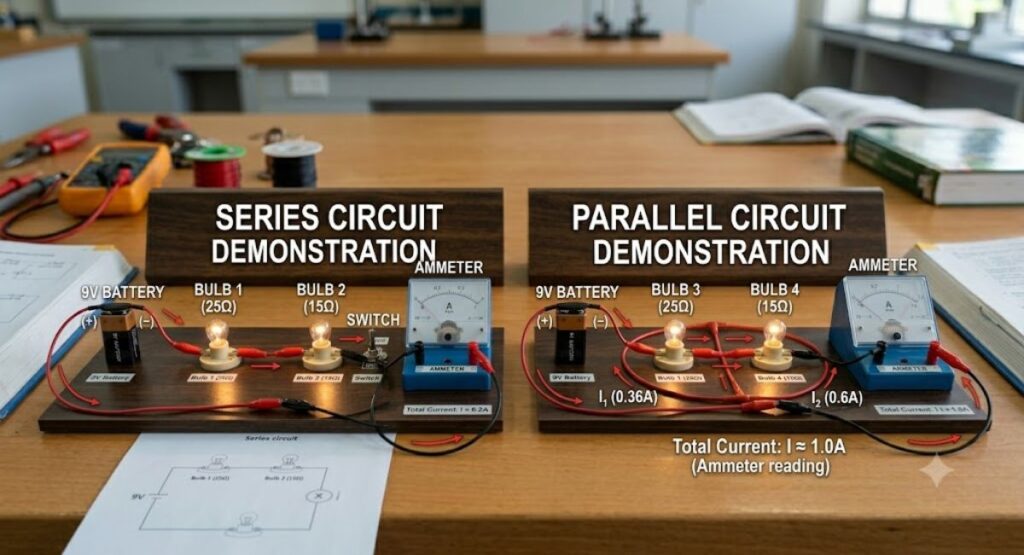
A series circuit is a type of electrical circuit in which all components are connected in a single path. The electric current flows through each component one after another before returning to the power source.
In a series circuit, there is only one route for electricity to travel. If one component fails or is disconnected, the entire circuit stops working because the path is broken.
For example, old-style Christmas tree lights often used series circuits. If one bulb burned out, all the lights would go out because the electrical path was interrupted.
How a Series Circuit Works
In a series circuit, the same current flows through every component. The total voltage supplied by the power source is divided among the connected devices.
Suppose three light bulbs are connected in series to a battery. The current passes through the first bulb, then the second, and finally the third bulb before returning to the battery.
Key characteristics of a series circuit include:
- Only one path for current flow
- Same current through all components
- Total resistance increases as more components are added
- Voltage is shared among devices
As additional components are added, resistance increases, which reduces the overall current in the circuit.
Advantages of a Series Circuit
Series circuits offer several benefits in specific situations.
- Simple and easy to design
- Requires fewer wires
- Cost-effective for basic applications
- Easy to understand and troubleshoot in small systems
Because of their simplicity, series circuits are commonly used in educational demonstrations and basic electronic projects.
Disadvantages of a Series Circuit
Despite their simplicity, series circuits have some significant limitations.
- Failure of one component affects the entire circuit
- Devices receive only a portion of the total voltage
- Adding more components reduces current flow
- Less suitable for household electrical systems
These drawbacks make series circuits less practical for applications where reliability is important.
What Is a Parallel Circuit?
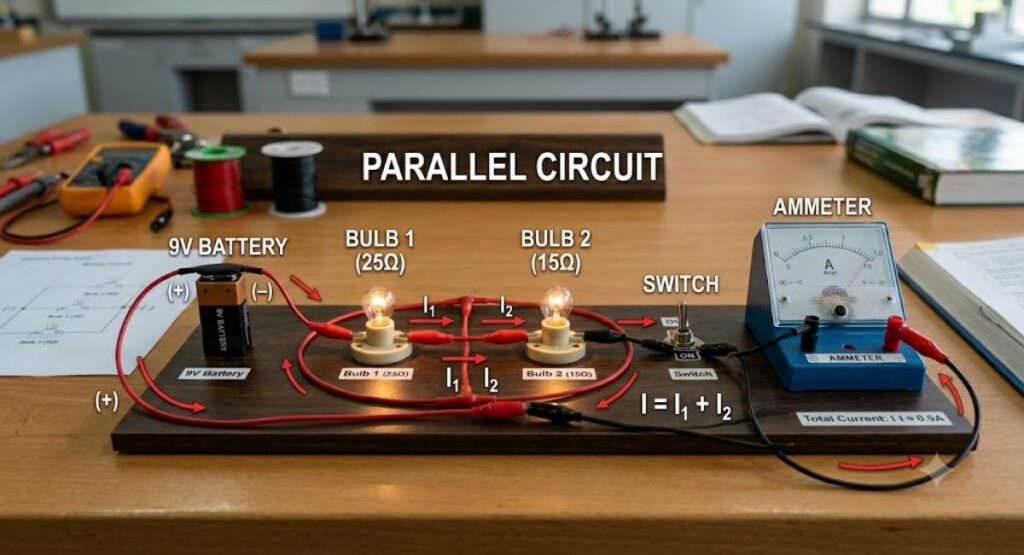
A parallel circuit is a type of electrical circuit in which components are connected across multiple branches. Each branch provides a separate path for electric current.
In this arrangement, electricity can flow through different paths simultaneously. If one component stops working, the remaining components continue operating because their paths remain complete.
Most residential electrical systems use parallel circuits because they provide reliable and independent operation for appliances and lights.
How a Parallel Circuit Works
In a parallel circuit, each branch receives the full voltage supplied by the power source. The total current is divided among the branches based on their resistance.
For example, if three light bulbs are connected in parallel, each bulb receives the same voltage. If one bulb burns out, the others continue to glow normally.
Important characteristics include:
- Multiple paths for current flow
- Same voltage across all branches
- Current is divided among components
- Components operate independently
This design ensures consistent performance for connected devices.
Advantages of a Parallel Circuit
Parallel circuits are widely used because of their many advantages.
- Components work independently
- Failure of one device does not affect others
- Full voltage is available to every branch
- Easy to add additional devices
- Reliable for homes and commercial buildings
These benefits make parallel circuits the preferred choice for most practical electrical installations.
Disadvantages of a Parallel Circuit
Although highly effective, parallel circuits also have some drawbacks.
- Requires more wiring
- Installation can be more complex
- Higher material costs
- Greater total current demand from the power source
Despite these disadvantages, the advantages often outweigh the additional costs.
Series Circuit vs Parallel Circuit: Major Differences
| Feature | Series Circuit | Parallel Circuit |
|---|---|---|
| Current Path | Single path | Multiple paths |
| Current Flow | Same through all components | Divided among branches |
| Voltage Distribution | Shared among devices | Same across all devices |
| Reliability | One failure stops entire circuit | Other devices continue working |
| Wiring Requirement | Less wiring | More wiring |
| Resistance | Increases with added components | Decreases as branches are added |
| Common Use | Simple electronics and educational projects | Homes, offices, and industries |
| Device Performance | May decrease with additional loads | Remains consistent |
Applications of Series Circuits
Series circuits are used in various situations where simplicity is more important than reliability.
Common applications include:
- Flashlights
- Battery-powered toys
- Educational laboratory experiments
- Certain decorative lighting systems
- Basic electronic testing circuits
These applications benefit from the straightforward design of series circuits.
Applications of Parallel Circuits
Parallel circuits are found in many modern electrical systems.
Examples include:
- Household wiring
- Office electrical installations
- Street lighting systems
- Industrial machinery
- Computer systems
- Automotive electrical systems
The ability to keep devices functioning independently makes parallel circuits highly practical.
Which Circuit Is Better?
The choice between a series circuit and a parallel circuit depends on the intended application.
For simple and low-cost projects, a series circuit may be sufficient. However, for most real-world electrical systems, a parallel circuit is usually the better option because it provides reliability, flexibility, and consistent performance.
Homes and businesses rely heavily on parallel circuits because they allow appliances and lights to function independently. If one device fails, the rest of the system continues operating normally.
Conclusion
Series and parallel circuits are the two fundamental methods of connecting electrical components. A series circuit provides a single path for current and is simple to construct, but it has limitations in reliability and performance. A parallel circuit offers multiple current paths, allowing devices to operate independently while receiving full voltage from the power source.
Understanding the differences between these circuit types helps in selecting the right configuration for electrical projects, educational purposes, and practical installations. While series circuits remain useful for basic applications, parallel circuits dominate modern electrical systems due to their efficiency and dependability.
FAQs
Q: What is the main difference between a series circuit and a parallel circuit?
A: A series circuit has one path for current flow, while a parallel circuit has multiple paths for electricity to travel.
Q: Why are homes wired in parallel instead of series?
A: Parallel wiring allows appliances and lights to operate independently. If one device fails, the others continue working.
Q: Which circuit has the same current through all components?
A: A series circuit has the same current flowing through every component.
Q: Which circuit provides the same voltage to all devices?
A: A parallel circuit provides the same voltage across all connected devices.
Q: Is a parallel circuit safer for everyday use?
A: Yes, parallel circuits are generally more practical and reliable because a single device failure does not shut down the entire system.