
Have you ever typed “Natzi” and wondered whether it was correct? You’re not alone. Thousands of people search for “Natzi or Nazi” every month because the word’s pronunciation can make its spelling seem confusing.
Fortunately, the answer is simple.
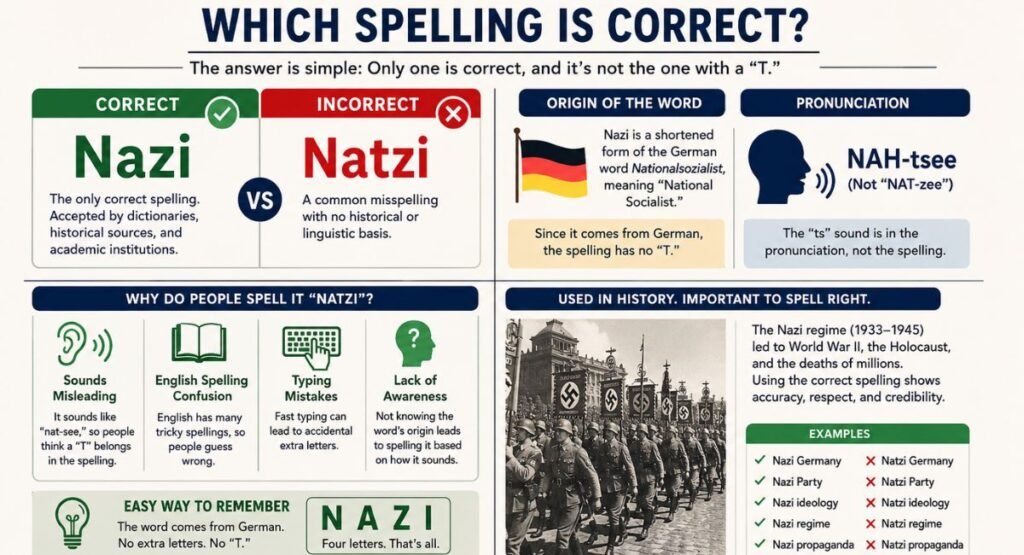
“Nazi” is the only correct spelling. “Natzi” is a misspelling that isn’t recognized by dictionaries, history books, academic institutions, or major style guides.
Although the extra T might seem harmless, using the wrong spelling can make your writing look inaccurate, especially when discussing an important historical topic. Whether you’re writing a school assignment, publishing an article, or simply satisfying your curiosity, knowing the correct form helps you communicate with confidence.
In this guide, we’ll explain why “Nazi” is correct, where the word comes from, why so many people mistakenly write “Natzi,” and how to remember the proper spelling forever.
Quick Answer
If you’re short on time, here’s the answer:
| Spelling | Correct? | Explanation |
|---|---|---|
| Nazi | ✅ Yes | The official and historically accurate spelling. |
| Natzi | ❌ No | A common spelling mistake with no linguistic or historical basis. |
No respected dictionary or historical reference accepts Natzi as an alternative spelling.
Why People Search for “Natzi or Nazi”
English is full of words that sound different from how they’re written, so it’s easy to understand why this question comes up.
When many English speakers hear the word “Nazi,” they naturally hear a sound similar to “nat-see.” Because of that pronunciation, some assume there should be a T before the Z.
That assumption is understandable, but it’s incorrect.
The spelling has never included the letter T, and it never should.
What Does the Word “Nazi” Mean?
The word “Nazi” refers to a member of the National Socialist German Workers’ Party, the political party led by Adolf Hitler in Germany.
The party came to power in 1933 and remained in control until the end of World War II in 1945.
Today, the term is commonly used in discussions about the following:
- World War II
- Adolf Hitler
- Nazi Germany
- The Holocaust
- European history
- Political ideologies
- Human rights and historical education
Because of the events associated with the Nazi regime, the word carries significant historical weight and should always be used accurately and respectfully.
The Origin of the Word Nazi
One of the easiest ways to remember the correct spelling is to understand where the word came from.
“Nazi” is not an English invention. It comes directly from the German language.
It is a shortened form of the German word “Nationalsozialist,” which translates to “National Socialist” in English.
Instead of repeatedly saying the full political party name, Germans shortened it to Nazi, and that abbreviated form eventually became recognized worldwide.
Since English borrowed the word directly from German, its spelling remained unchanged.
That’s why the correct spelling is simply
N-A-Z-I
There has never been a T in the original German abbreviation.
Why Do So Many People Spell It “Nazi”?
Although Natzi is incorrect, there are several understandable reasons why people make this mistake.
Pronunciation Can Be Misleading
The biggest reason is pronunciation.
When spoken naturally, “Nazi” sounds like
NAH-tsee
Many people mistakenly believe that the “ts” sound must be represented with the letter T in writing.
However, pronunciation doesn’t always determine spelling.
Many English words contain sounds that aren’t reflected exactly by their letters, and this is one of those cases.
English Spelling Rules Can Be Confusing
English borrows words from dozens of different languages.
Some words follow English pronunciation patterns, while others keep their original foreign spellings.
Since “Nazi” comes from German, it follows German spelling—not English phonetics.
That’s why adding a T changes the word into a spelling error.
Fast Typing Creates Mistakes
Sometimes the mistake has nothing to do with pronunciation.
People type quickly, especially on phones or social media.
A single extra letter can easily slip into a word without being noticed.
Once copied by others, the misspelling spreads online.
lack of Historical Knowledge
Many younger readers first encounter the word online rather than in history books.
Without knowing its German origin, they simply spell the word the way they hear it.
This explains why Natzi appears in internet searches even though it isn’t correct.
How to Pronounce Nazi Correctly
Understanding the pronunciation can actually help prevent future spelling mistakes.
The standard pronunciation is
NAH-tsee
Break it into two simple parts:
- NAH
- see
Notice something important.
The “t” sound belongs to the pronunciation, not the spelling.
The letters themselves remain:
N-A-Z-I
Not:
N-A-T-Z-I
That’s the distinction many people miss.
Natzi vs Nazi: Side-by-Side Comparison
Sometimes a quick comparison makes everything clear.
| Incorrect | Correct |
|---|---|
| Nazi Germany | Nazi Germany |
| Natzi Party | Nazi Party |
| Nazi regime | Nazi regime |
| Natzi propaganda | Nazi propaganda |
| Natzi soldiers | Nazi soldiers |
| Natzi ideology | Nazi ideology |
Every example on the left contains a spelling error.
Every example on the right follows accepted English usage.
Why Correct Spelling Matters
Some spelling mistakes are harmless.
This isn’t one of them.
Because “Nazi” refers to one of the most significant political movements in modern history, accuracy matters.
It Improves Your Credibility
Readers expect historical terms to be spelled correctly.
Whether you’re writing a blog, academic essay, news article, or research paper, correct spelling immediately makes your work appear more trustworthy.
A simple typo can distract readers from your message.
It Shows Respect for History
The Nazi regime was responsible for immense suffering, including the Holocaust and millions of deaths during World War II.
Using accurate terminology demonstrates care when discussing these events.
Although a spelling mistake is usually unintentional, getting it right reflects attention to detail.
It Prevents Confusion
Language works best when everyone uses the same standard spelling.
Since Natzi has no accepted meaning, using it only creates unnecessary confusion for readers.
Using “Nazi” keeps your writing clear and historically accurate.
Common Places You’ll See the Word Nazi
The word appears in many different contexts today.
Some of the most common include the following:
- History textbooks
- Museum exhibits
- Academic research
- World War II documentaries
- News articles
- Political discussions
- Educational websites
- Historical biographies
In all of these sources, the spelling is always Nazi.
You will never find Natzi used as the accepted form.
Is “Grammar Nazi” an Appropriate Expression?
Many English speakers use expressions such as “grammar Nazi,” “fitness Nazi,” or “fashion Nazi” to describe someone who is extremely strict.
Although these phrases are common in casual conversation, they are also controversial.
Many historians, educators, and readers believe such comparisons trivialize the crimes committed by the Nazi regime.
If you’re writing professionally, it’s usually better to choose alternatives such as:
- Grammar perfectionist
- Grammar enthusiast
- Strict editor
- Detail-oriented reviewer
These alternatives communicate the same idea without referencing a historical tragedy.
Easy Trick to Remember the Correct Spelling
Need a simple memory hack?
Remember this sentence:
German word. German spelling. No extra T.
Or think of it another way.
The word contains only four letters:
N
A
Z
I
If you find yourself adding another letter, you’ve probably made a mistake.
It’s that easy.
Common Mistakes to Avoid
Here are some errors people frequently make:
❌ Natzi
❌ Natzie
❌ Natsi
❌ Nazti
✅ Nazi
Only one spelling is accepted in modern English.
Frequently Asked Questions
Is Natzi a real word?
No.
Natzi is not recognized by English dictionaries or historical references. It is simply a misspelling of Nazi.
Why do people write Natzi?
Most people spell it that way because they hear a “ts” sound when the word is spoken and assume a T belongs in the spelling.
Where did the word “Nazi” originate?
It comes from the German word “Nationalsozialist,” meaning “National Socialist.”
Should “Nazi” always begin with a capital letter?
Yes.
Since it refers to a specific political movement and its members, “Nazi” should always be capitalized.
Is Nazi an English word?
The word is borrowed from German but has become a standard part of English vocabulary.
Can I use Nazi in casual comparisons?
You can, but many people consider such comparisons insensitive because they reference one of history’s darkest periods. In professional writing, choosing a more precise alternative is usually the better option.
Final Thoughts
If you’ve been wondering whether to write Natzi or Nazi, the answer couldn’t be clearer.
“Nazi” is the only correct spelling. It appears in dictionaries, academic publications, historical records, and every reputable source discussing World War II and modern history.
The confusion comes from pronunciation, not from the word itself. Because English borrowed the term directly from German, its spelling has never included an extra T.
The next time you write about Nazi Germany, Adolf Hitler, or World War II, remember the simple rule:
Four letters. One correct spelling. Nazi.
Using the proper spelling not only strengthens your writing but also reflects accuracy and respect when discussing an important chapter of world history.