
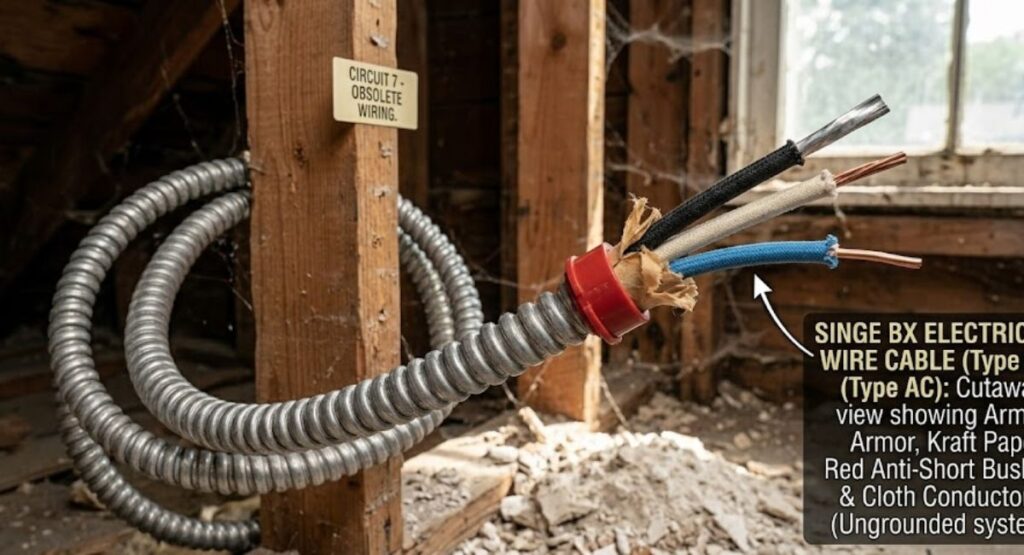
What Is BX Electrical Cable?
BX cable is the popular trade name for armored electrical cable a set of insulated wires bundled together and protected by a flexible, ribbed metal outer jacket. The “BX” name started as a brand designation: inventor Edwin T. Greenfield produced his armored cable in two experimental versions, “AX” and “BX,” and the second version was the one that stuck. Much like how people call all adhesive bandages “Band-Aids,” the trade became so dominant that the brand name became the common term for the entire product category.
Formally, the modern National Electrical Code (NEC) does not use the term “BX” at all. Today’s official designations are Type AC (Armored Cable, NEC Article 320) and Type MC (Metal-Clad Cable, NEC Article 330). However, electricians and homeowners still use “BX” interchangeably with armored cable in everyday conversation, and you will hear it constantly in the trades.
“BX cable is to armored electrical wiring what ‘Band-Aid’ is to adhesive bandages a brand name so dominant it became the everyday word for an entire product category.”
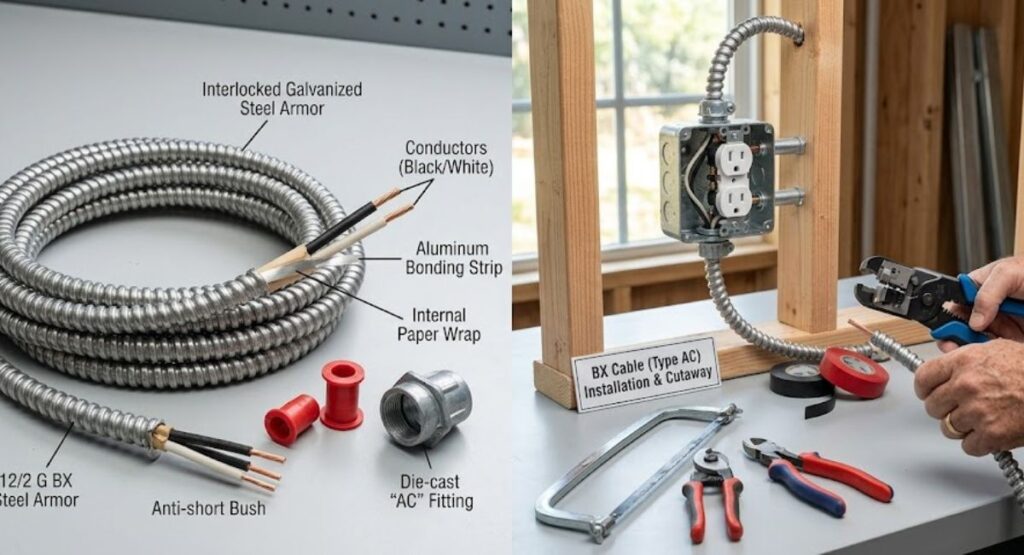
How Is BX Cable Constructed?
Understanding what is inside BX cable helps you appreciate both its strengths and its limitations and explains why old BX wiring in particular deserves attention.
A standard armored cable assembly contains the following layers from the inside out. At the core are the conductors typically copper wires that carry electrical current. Each conductor is wrapped in plastic (PVC) insulation to prevent the wires from touching each other. Surrounding all the conductors is the defining feature of BX cable: a flexible metallic sheath made from helically wound, interlocking strips of steel or aluminum. This gives the cable its distinctive ribbed appearance and lets it bend around corners while resisting crushing and puncture.
In older BX installations from the 1920s through the 1950s, the conductor insulation was rubber and cloth rather than modern PVC. This is the single most important thing to understand about vintage BX cable that old insulation degrades over decades, becoming brittle, cracking, and eventually failing entirely.
Where Is BX Cable Used?
BX cable earns its place in situations where standard non-metallic (NM) cable the plastic-sheathed “Romex” familiar from most modern homes simply does not offer enough protection.
Commercial and industrial environments
In factories, warehouses, and commercial buildings where cables run in exposed locations and face a real risk of being struck, crushed, or scraped, the metal armor of BX cable acts as a sturdy mechanical barrier that NM cable cannot match. It is commonly specified for basement runs, utility rooms, machine rooms, and any installation where wiring will be visible and vulnerable.
Residential exposed wiring
In homes, BX cable is required or preferred when wiring runs through unfinished spaces like attics, crawlspaces, or garages especially where the cable will not be hidden behind drywall. Some local codes mandate armored cable in these locations. Its flexibility allows it to navigate around obstacles and through wall cavities where rigid conduit would be impractical.
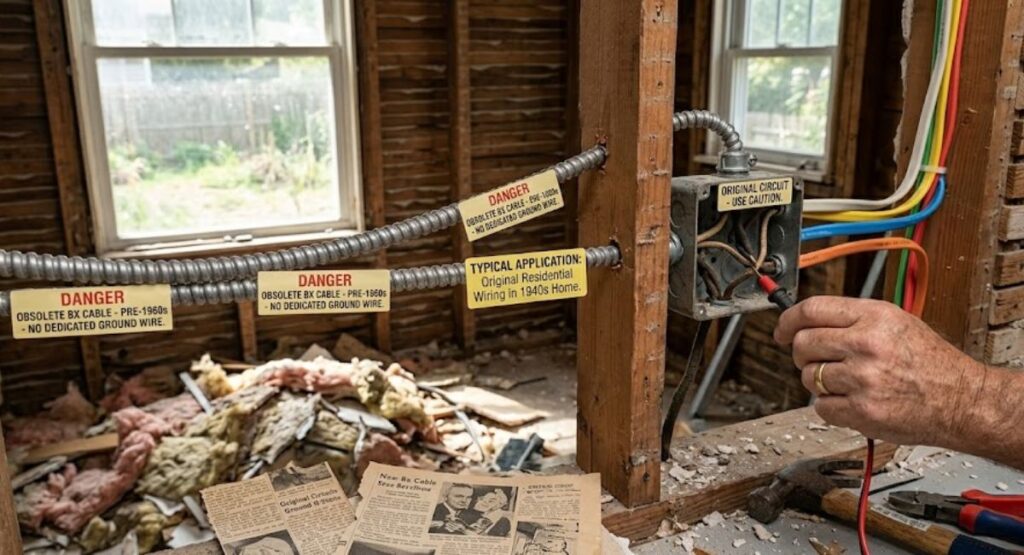
Retrofit and renovation projects
When adding circuits to an older home, BX cable is often the most practical choice because it provides built-in mechanical protection without needing to install a separate conduit saving both time and money on labor-intensive retrofit work.
Hazardous and demanding locations
Armored cable is specified for stairwells, barns, basements, and areas prone to moisture or rodent activity. Its metal jacket resists gnawing far better than plastic-sheathed alternatives, and certain varieties handle exposure to UV light and mechanical stress that would damage standard NM cable.
Good to know
Unlike NM cable, which must always be installed in an enclosed location (inside a wall, ceiling, or under a floor), some types of BX cable can be left exposed either indoors or in certain outdoor settings. Always check with your local building code before leaving armored cable exposed.
BX vs. NM Cable (Romex): Key Differences
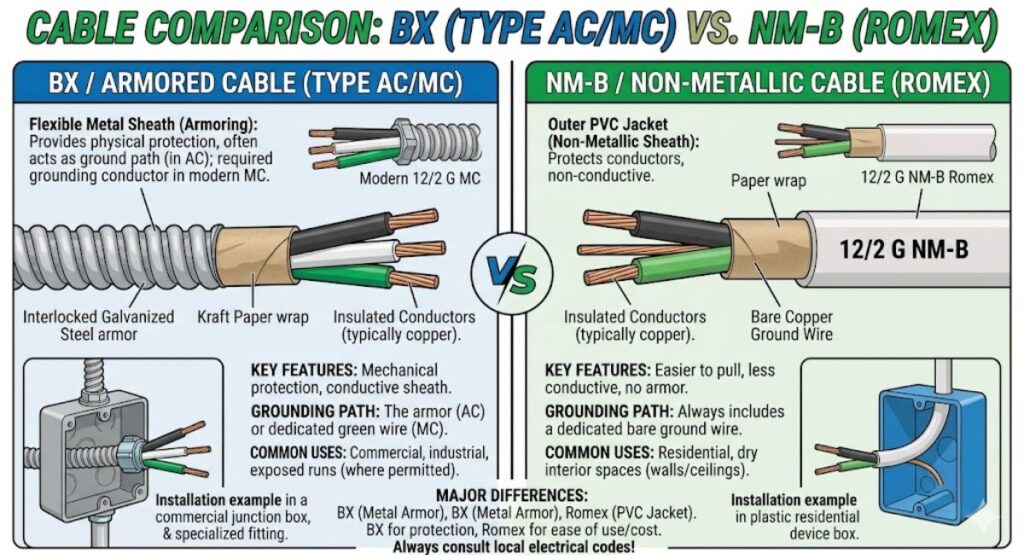
| Feature | BX / Armored Cable | NM Cable (Romex) |
|---|---|---|
| Outer protection | Interlocking metal armor | Vinyl plastic sheath |
| Mechanical protection | Excellent | Limited |
| Can be left exposed | Yes (check local code) | No — must be enclosed |
| Cost | ~25% more expensive | Cheaper |
| Ease of installation | Heavier, stiffer | Lightweight, easy to pull |
| Cutting tool required | Hacksaw or rotary cutter | Standard wire stripper |
| NEC accepted | Yes | Yes |
BX vs. MC Cable: What Is the Real Difference?
This is where most confusion happens even among experienced DIYers. BX (Type AC) and MC (Type MC, Metal-Clad) look nearly identical from the outside, but there is one critical difference that affects both safety and installation requirements.
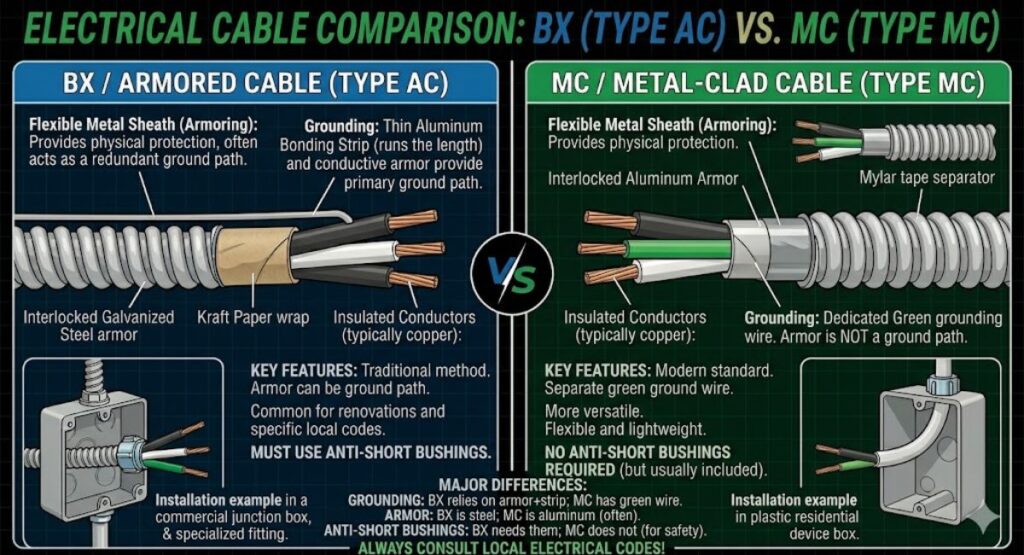
| Feature | Type AC (BX) | Type MC (Metal-Clad) |
|---|---|---|
| Grounding method | Metal armor + internal bonding strip | Dedicated green/bare copper ground wire inside |
| Max conductors | Up to 4 | No limit |
| Suitable for wet locations | No | Some types approved |
| Flexibility | More flexible | Slightly stiffer |
| Typical use | Residential, light commercial | Commercial, industrial |
| Grounding reliability | Depends on armor continuity | More reliable (dedicated wire) |
The grounding difference matters enormously. Type AC relies on its spiral metal armor — plus a small uninsulated aluminum bonding strip running inside the sheath — to serve as the equipment grounding path. This bonding strip must be tucked back into the box connector at every termination to make proper contact. If it is not, or if connections loosen over time, the grounding path fails.
Type MC cable sidesteps this problem by including a full-sized, dedicated grounding conductor (a green or bare copper wire) running alongside the circuit wires inside the armor. This makes the grounding path independent of the armor’s physical condition, which is why MC cable is considered more versatile and reliable for demanding environments.
How to Install BX Cable: Step-by-Step
- Choose the right cable.Use 12-gauge for 20-amp circuits and 14-gauge for 15-amp circuits. Confirm with your local code whether Type AC or Type MC is required for your application.
- Measure and cut the cable.Use a rotary armored cable cutter (such as a Roto-Split) for clean, safe cuts it slices the armor without touching the inner wires. Alternatively, score the armor with a hacksaw at a 45-degree angle and snap it off. Always wear gloves; cut armor edges are razor-sharp.
- Remove the armor.After cutting, bend the armor back and forth until it snaps cleanly. Pull back and remove the disconnected section, then carefully strip the paper wrapping around the conductors.
- Insert the anti-short bushing.This small insulating ring known as a “redhead” for its typical red color must be placed between the conductors and the cut end of the metal armor. It prevents the sharp armor edge from cutting into the conductor insulation and causing a short circuit. This step is non-negotiable.
- Connect the box connector.Slide a BX-specific box connector over the armor end. The connector grips the armor and, critically, ensures the bonding strip makes electrical contact to complete the grounding path.
- Secure the cable.Support the cable at regular intervals the NEC requires support within 12 inches of every box and every 4.5 feet along the run. Use approved cable clamps or straps.
- Make your connections.Connect the conductors inside the junction box: black to hot, white to neutral, and the ground (either the bonding strip tucked back, or the dedicated ground wire in MC cable) to the grounding terminal.
Pro Tip
Do not overbend BX cable during installation. Bending too sharply can distort the armor and damage the conductor insulation inside. A good rule of thumb is to keep any bend to a radius of at least five times the cable’s diameter.
Old BX Wiring in Your Home: Should You Be Worried?
This is the question most homeowners actually need answered. If your house was built between the 1920s and the 1960s and still has original wiring, you may well have first-generation BX and it deserves serious attention.
⚠ Safety Warning — Old Ungrounded BX
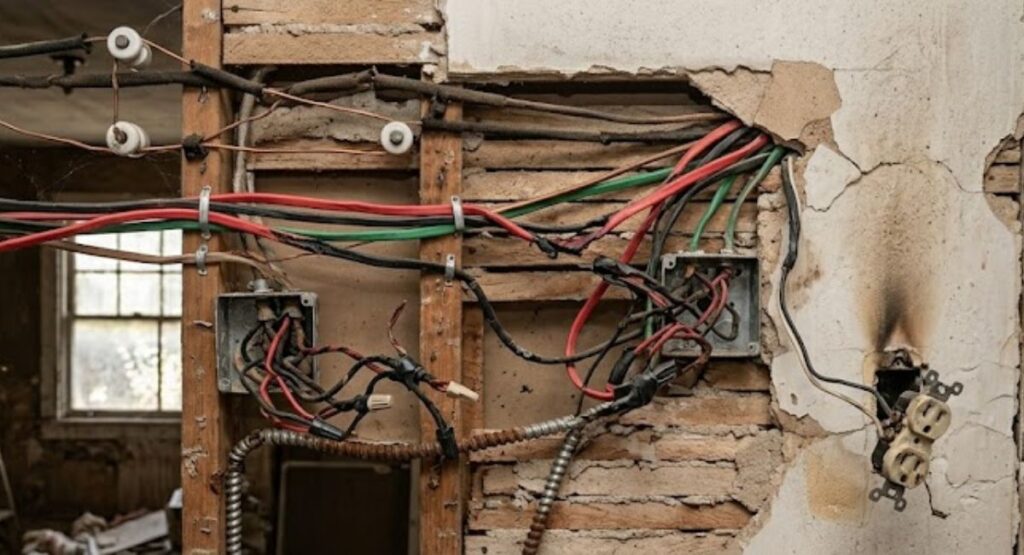
First-generation BX cable (pre-1960s) presents multiple hazards: the rubber-and-cloth insulation deteriorates and crumbles with age; the metal armor was designed as the sole grounding path, and connections loosen over decades; without a dedicated ground wire, shock risk is higher; and smaller-gauge BX was never designed for today’s electrical loads. This type of wiring is not compliant with modern three-prong grounded outlets or current electrical codes.
The key warning signs to look for in your home include visible armor damage or rust on the cable jacket, cloth-insulated conductors that crack or crumble when gently touched, ungrounded two-prong outlets throughout the house, overheating or discoloration near junction boxes, and frequently tripping circuit breakers on older circuits.
If you spot any of these, the right move is to have a licensed electrician assess the system. In many cases, full replacement is the safest and most cost-effective long-term solution especially since modern rewiring methods can often be performed with minimal disruption to walls and ceilings.
Is BX Cable Still a Good Choice for New Installations?
Absolutely with the right context. Modern armored cable (Type AC or MC) is a legitimate, code-compliant wiring choice in 2026, and it is actively preferred in specific situations. If you are wiring an exposed garage workshop, running circuits through an unfinished basement, or working on a commercial retrofit where physical cable protection is a priority, armored cable is often the smarter choice than standard NM cable.
The main trade-offs are cost (armored cable runs roughly 25% more expensive than NM cable) and ease of installation (it is heavier, stiffer, and requires more specialized tools). For wiring that will be hidden behind drywall in a typical residential setting, NM cable is perfectly adequate and considerably easier to work with.
The decision ultimately comes down to the environment. Where cables are exposed, where mechanical damage is a realistic risk, or where local code demands it BX-style armored cable is the right tool for the job.
Frequently Asked Questions
What does BX stand for in electrical cable?
BX is a historical trade name, not an acronym. It originated from inventor Edwin Greenfield’s two experimental armored cable designs “AX” and “BX” where the “X” stood for experimental. The “B” version proved more successful and the name stuck across the industry.
Is BX cable the same as Romex?
No. Romex is a brand name for NM (non-metallic) cable, which has a plastic vinyl outer sheath. BX cable has a flexible metal armor jacket. They serve different purposes BX offers superior mechanical protection while Romex is lighter, cheaper, and easier to install in enclosed spaces.
Can I use BX cable outdoors?
Standard Type AC (BX) cable is not rated for wet or outdoor locations. However, certain Type MC cables with additional PVC jacketing are approved for outdoor and wet location use. Always check the cable’s labeling and your local electrical code before any outdoor installation.
How do I know if my old BX wiring is still safe?
Have a licensed electrician inspect it. Key danger signs include brittle or crumbling cloth insulation, loose connections at junction boxes, ungrounded two-prong outlets, rust or physical damage on the armor, and circuits that trip frequently. If the wiring dates from before the 1960s, a professional assessment is strongly recommended.
What tool do I need to cut BX cable?
A rotary armored cable cutter (like the Roto-Split) is the safest and most effective tool it slices the armor without reaching the inner wires. For occasional cuts, you can use a hacksaw at a 45-degree angle or carefully bend the cable to crack the armor open. Always wear gloves; the cut edges are very sharp.
Do I need a permit to replace BX wiring?
In most jurisdictions, yes. Replacing branch-circuit wiring is typically a permitted and inspected electrical job, even for small sections. Contact your local building department or have your electrician pull the necessary permits this also protects you when selling your home.