
introduction
Dark Souls is one of the most recognised action role-playing games ever released. Even players who have never entered the ruined kingdom of Lordran have probably heard about its difficult enemies, hidden paths, large boss fights, and unusual way of telling a story.
The game is commonly called Dark Souls 1 because it became the first title in the Dark Souls series. However, its official name is simply Dark Souls. It was developed by FromSoftware and directed by Hidetaka Miyazaki. The game followed many ideas introduced in Demon’s Souls, but it created a new world, new characters, and a different story.
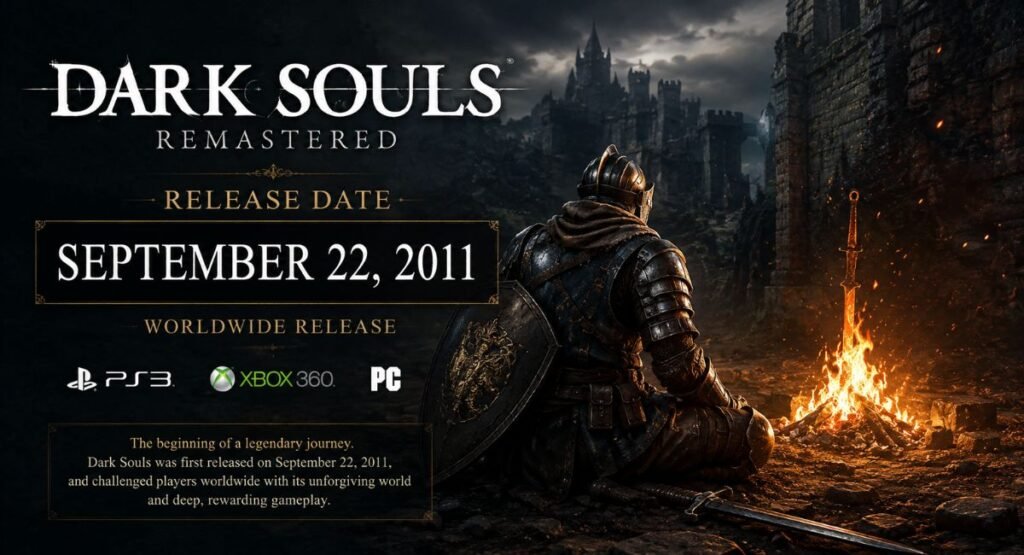
The original Dark Souls 1 release date was September 22, 2011, in Japan. It was first released there for the PlayStation 3. The North American version arrived on October 4, 2011, while the European release followed on October 7, 2011.
Since its first launch, Dark Souls has received a PC edition, additional content, a remastered version, and releases on newer gaming systems. This article explains the complete Dark Souls 1 release history, available platforms, major editions, and reasons the game remains popular.
When Did Dark Souls 1 Come Out?
Dark Souls 1 originally came out on September 22, 2011. This date applies to the Japanese PlayStation 3 release.
Players in North America received the game on October 4, 2011, for PlayStation 3 and Xbox 360. The European version was released three days later on October 7, 2011. The different launch dates were caused by the publishing, distribution, rating, and localisation processes used in each region.
FromSoftware’s official product information lists September 22, 2011, as the Japanese release date. Bandai Namco’s European website lists October 7, 2011, for the European launch. Namco Bandai also announced October 4, 2011, as the North American release date for PlayStation 3 and Xbox 360.
Although the regional dates were different, all three releases introduced players to the same main journey through Lordran.
Dark Souls 1 Release Date Table
The game has appeared in several forms since 2011. The following table shows the most important releases.
| Version | Platform | Release date | Main details |
|---|---|---|---|
| Dark Souls | PlayStation 3 in Japan | September 22, 2011 | Original Japanese release |
| Dark Souls | PlayStation 3 and Xbox 360 in North America | October 4, 2011 | First North American release |
| Dark Souls | PlayStation 3 and Xbox 360 in Europe | October 7, 2011 | Original European release |
| Prepare to Die Edition | Windows PC | August 24, 2012 | PC version with extra content |
| Artorias of the Abyss Edition | PlayStation 3 and Xbox 360 | 2012 | Console release containing additional content |
| Dark Souls Remastered | PlayStation 4, Xbox One and PC | May 2018 | Improved resolution, performance and multiplayer |
| Dark Souls Remastered | Nintendo Switch | October 2018 | Portable and home-console version |
The Windows release of Prepare to Die Edition arrived on August 24, 2012. Dark Souls Remastered later launched on modern systems in May 2018, while the Nintendo Switch version followed in October 2018.
What Platforms Had the Original Game?
The original console version of Dark Souls was released for PlayStation 3 and Xbox 360.
In Japan, the game initially appeared on PlayStation 3. International markets received both PlayStation 3 and Xbox 360 versions. This allowed Dark Souls to reach a wider audience than Demon’s Souls, which was connected closely with the PlayStation 3.
The Xbox 360 release was important because it introduced FromSoftware’s style of action role-playing to players who did not own a PlayStation console. Both versions offered the same main areas, bosses, weapons, armour, magic systems, online features, and character-building options.
The original versions also had technical limits. Some areas suffered from unstable frame rates, with Blighttown becoming the most famous example. These problems did not stop players from appreciating the connected world, careful combat, and rewarding sense of progress.
Was Dark Souls the First Souls Game?
Dark Souls was not the first game created in the wider Souls style.
FromSoftware released Demon’s Souls for PlayStation 3 before Dark Souls. Demon’s Souls introduced several ideas that later became closely connected with the series. These included losing collected currency after death, recovering it by returning to the place of death, resting at checkpoints, reading messages left by other players, and fighting powerful bosses.
Dark Souls was described as a spiritual successor rather than a direct story sequel to Demon’s Souls. It used familiar gameplay ideas but placed them inside a separate world with different history, locations, characters, and rules. Bandai Namco’s official page also describes Dark Souls as a spiritual successor rather than a direct Demon’s Souls sequel.
The name Dark Souls later became the title of the full series. It was followed by Dark Souls II and Dark Souls III.
Why Was the 2011 Release Important?
The 2011 release of Dark Souls affected the action role-playing genre in several major ways.
At the time, many games were becoming more direct. They often used clear maps, objective markers, detailed tutorials, and frequent instructions. Dark Souls followed a different approach. It gave players limited guidance and expected them to learn through observation, failure, practice, and careful exploration.
The game did not make progress easy. Regular enemies could defeat an unprepared character. Traps were placed in unexpected locations. Bosses demanded patience, and careless attacks were often punished.
However, Dark Souls was not difficult simply for the sake of being difficult. Its challenge was connected to learning. Players gradually understood enemy attack patterns, weapon timing, stamina control, shortcuts, and level design.
This made victory feel personal. Defeating a boss after several failed attempts created a level of satisfaction that many players had not experienced in other games.
The success of this system helped popularise the term “Soulslike.” Today, that word is used for games that include challenging combat, checkpoint-based progress, dangerous worlds, indirect storytelling, and penalties after death.
What Is Dark Souls About?
Dark Souls takes place in Lordran, a dark kingdom filled with ruined castles, ancient gods, cursed humans, strange creatures, and fading fire.
The player controls an undead character who has been imprisoned because of a curse. After escaping the Northern Undead Asylum, the character travels to Lordran and begins a journey connected to the fading Age of Fire.
The main story is not presented through long explanations. Players learn about the world through conversations, item descriptions, environmental details, and small clues.
Important characters may provide information, but they rarely explain everything. Some characters can disappear, become hostile, lose hope, or die depending on the player’s actions.
This storytelling style encouraged players to discuss theories and compare discoveries. Even years after the original Dark Souls 1 release date, fans continue to debate its history, characters, endings, and hidden meanings.
The World of Lordran
One of the strongest parts of Dark Souls is the design of Lordran.
Many areas are physically connected. A door opened late in one section may create a shortcut back to an earlier bonfire. A distant building seen from one location may later become a place the player can enter.
This connected layout gives the world a believable structure. Lordran feels like one large place rather than a collection of separate levels.
Players begin around Firelink Shrine, which acts as an early central area. From there, they can reach places such as Undead Burg, New Londo Ruins, the Catacombs, and Blighttown.
The game allows some freedom in the order of exploration. A new player can accidentally enter a dangerous area before being properly prepared. This can create frustration, but it also teaches an important lesson: leaving an area and returning later is sometimes the correct decision.
How Combat Works
Dark Souls uses careful, stamina-based combat.
Attacking, blocking, rolling, and running consume stamina. A player who attacks too many times may have no stamina left to defend against the enemy’s response.
Weapons also behave differently. Swords, axes, spears, clubs, bows, and large weapons have their own attack speed, range, damage type, and movement pattern.
A heavy weapon may cause great damage but require more strength and stamina. A smaller weapon may attack faster but offer less power with each hit.
Armour affects defence and movement. Wearing very heavy equipment can make rolling slower, while lighter equipment supports faster movement.
The game also includes magic, miracles, and pyromancy. This allows players to build characters around strength, dexterity, intelligence, faith, defence, or a mixture of several abilities.
There is no single correct build. Players can complete the game using many different weapons and strategies.
Dark Souls Prepare to Die Edition
The original PC version was called Dark Souls: Prepare to Die Edition.
It was released for Windows on August 24, 2012. This edition gave PC players access to the main game and additional content connected to Artorias of the Abyss.
Prepare to Die Edition introduced Dark Souls to a large PC audience, but its technical condition received criticism. The original port had limited resolution options, a fixed frame rate, and controls that did not always feel properly designed for keyboard and mouse.
Community developers created unofficial fixes that improved the experience. These fixes became popular among PC players and showed how strongly the community wanted to support the game.
Despite its technical problems, the PC version helped Dark Souls grow. More players created guides, gameplay videos, character builds, speedruns, challenge runs, and story discussions.
The Prepare to Die Edition is no longer the standard version sold to new players on major digital stores. Dark Souls Remastered has replaced it as the main modern release.
Artorias of the Abyss Content
Artorias of the Abyss added new areas, enemies, bosses, weapons, spells, and story information.
The additional journey is connected to the past of Lordran. It gives players more information about Knight Artorias, Manus, the Abyss, and the history of Oolacile.
Artorias had already been mentioned in the main game, but the extra content allowed players to see important events connected to his legend.
The expansion includes several memorable boss battles. Many players consider Knight Artorias and Manus among the strongest fights in the first Dark Souls game.
The additional content was included in Prepare to Die Edition and later became part of Dark Souls Remastered. PlayStation’s official listing confirms that the remastered edition contains the main game and the Artorias of the Abyss content. (PlayStation)
Dark Souls Remastered Release Date
Dark Souls Remastered brought the game to newer systems in 2018.
The remastered version became available for PlayStation 4, Xbox One, and PC in May 2018. Regional store listings show small date differences, with releases appearing around May 23 to May 25 because of location and platform timing.
The Nintendo Switch edition was released later. Bandai Namco announced that Dark Souls Remastered launched for Nintendo Switch on October 19, 2018, in North America. FromSoftware lists October 18, 2018, as the Japanese Switch release date.
Dark Souls Remastered includes the base game and Artorias of the Abyss content. It also provides higher display resolutions, improved performance on supported platforms, and updates to online multiplayer.
The remaster does not completely rebuild the original game. Its main goal is to make the existing Dark Souls experience work better on modern hardware.
Which Version Should You Play?
Dark Souls Remastered is the most practical version for most new players.
It is available on modern systems, includes the additional content, and offers better performance than the original PlayStation 3 and Xbox 360 editions.
Players who want portable access can choose the Nintendo Switch version. It allows the full adventure to be played in handheld mode or on a television.
PC, PlayStation, and Xbox versions may offer higher performance depending on the device being used. The best choice will depend on the system you own and whether portable play matters to you.
The original versions are still valuable to collectors and players interested in gaming history. However, they are less convenient for someone who simply wants to experience the game today.
Is Dark Souls Still Worth Playing?
Dark Souls is still worth playing because its strongest features have not depended on modern graphics.
Its connected world remains impressive. Its combat still rewards patience and planning. Its bosses remain memorable, and its character-building system offers many ways to approach the journey.
Some parts may feel old compared with newer games. Movement can feel slower, certain menus are less friendly, and a few mechanics are not explained clearly.
Those limits are unlikely to ruin the game for players who enjoy exploration, difficult battles, and mysterious storytelling.
Modern games have improved graphics and smoother controls, but few have copied Lordran’s world structure perfectly. The way areas connect continues to be one of the main reasons players return to the first Dark Souls.
How Old Is Dark Souls 1?
Dark Souls reached its 14th anniversary on September 22, 2025, based on its original Japanese release date.
It will turn 15 years old on September 22, 2026.
For a game released in 2011, it continues to have a highly active reputation. New players still share their first boss victories, while experienced players create challenge runs using unusual weapons, restricted character levels, or special rules.
Its age has also made it an important part of gaming history. Many current action role-playing games use ideas that became widely known through Dark Souls.
The Legacy of Dark Souls
Dark Souls did more than launch a successful series.
It changed how players and developers discussed game difficulty. It showed that a demanding game could attract a large audience when its rules were fair and its rewards felt meaningful.
The game also changed online communities. Players shared messages, warnings, jokes, and false directions through the game’s online system. Outside the game, they created wikis, guides, videos, and detailed story explanations.
Its influence can be seen in games that use limited healing, stamina-based combat, large boss encounters, dangerous checkpoints, and recoverable experience after death.
FromSoftware continued developing related ideas in later games, including Dark Souls II, Dark Souls III, Bloodborne, Sekiro: Shadows Die Twice, and Elden Ring.
Each title has its own world and systems, but the first Dark Souls remains an important point in FromSoftware’s history.
Final Thoughts
The original Dark Souls 1 release date was September 22, 2011, in Japan. It launched in North America on October 4, 2011, and Europe on October 7, 2011.
A Windows PC version called Prepare to Die Edition arrived in August 2012. Dark Souls Remastered later brought the complete game to PlayStation 4, Xbox One, PC, and Nintendo Switch in 2018.
What began as a demanding dark fantasy game grew into one of the most influential action role-playing releases of its generation.
Dark Souls remains popular because it respects the player’s ability to learn. It does not provide easy answers, but it gives players the tools required to improve. Every shortcut discovered, boss defeated, and hidden story uncovered feels earned.
More than a decade after its first release, the journey through Lordran continues to challenge new players.
FAQS
Q1. What is the exact Dark Souls 1 release date?
Answer: The original Dark Souls 1 release date was September 22, 2011, in Japan. It was released in North America on October 4, 2011, and in Europe on October 7, 2011.
Q2. What was Dark Souls 1 originally released on?
Answer: Dark Souls was originally released for PlayStation 3 in Japan. The North American and European releases were available for PlayStation 3 and Xbox 360.
Q3. When did Dark Souls 1 come out on PC?
Answer: Dark Souls came to Windows PC through Prepare to Die Edition on August 24, 2012. The PC edition included the main game and additional Artorias of the Abyss content.
Q4. When was Dark Souls Remastered released?
Answer: Dark Souls Remastered was released for PlayStation 4, Xbox One, and PC in May 2018. The Nintendo Switch version followed in October 2018.
Q5. Is Dark Souls 1 the same as Dark Souls Remastered?
Answer: Dark Souls Remastered contains the same main game, world, story, and bosses as Dark Souls 1. However, it offers technical improvements, updated multiplayer support, higher resolutions on supported platforms, and the Artorias of the Abyss content.
Q6. Is Dark Souls 1 connected to Demon’s Souls?
Answer: Dark Souls is a spiritual successor to Demon’s Souls, but it is not a direct story sequel. The two games share several gameplay ideas, but their worlds, characters, and stories are separate.
Q7. Does Dark Souls Remastered include the DLC?
Answer: Yes. Dark Souls Remastered includes the complete Artorias of the Abyss additional content, including its areas, bosses, weapons, characters, and story details.
Q8. Is Dark Souls 1 still worth playing in 2026?
Answer: Yes. Dark Souls remains a strong choice for players who enjoy challenging combat, connected world design, memorable bosses, character building, and indirect storytelling. Dark Souls Remastered is the easiest version to access on modern gaming systems.